Target Keywords: best polyurea spray machine 2025 | Graco Reactor 2 Elite review | polyurea coating for infrastructure
America’s infrastructure is in a state of urgent, government-funded renewal. The bipartisan Infrastructure Investment and Jobs Act allocated over $1.2 trillion toward bridges, roads, water systems, and public facilities — and professional coating contractors are at the very center of this transformation. When concrete cracks, steel corrodes, and water finds its way where it shouldn’t, polyurea coatings applied with high-pressure plural component spray machines are the proven solution. And in 2025, one machine stands above all others: the Graco Reactor 2 Elite.
If you’ve been searching for the best polyurea spray machine 2025 has to offer, or you’re looking for a thorough Graco Reactor 2 Elite review before making your investment, this article covers everything — from its technical specifications and real-world performance to its role in the booming market for polyurea coating for infrastructure projects nationwide.
Why Polyurea Coatings Are Dominating Infrastructure Projects in 2025
The surge in infrastructure spending has created unprecedented demand for high-performance protective coatings. Polyurea has emerged as the preferred solution for engineers, contractors, and facility managers because it outperforms every competing technology in the categories that matter most on large-scale projects: speed, durability, flexibility, and chemical resistance.
According to the Polyurea Development Association (PDA), polyurea coatings have been used on projects ranging from bridge deck waterproofing and secondary containment to water treatment facilities and military blast-mitigation structures. The chemistry delivers a gel time as fast as 3–5 seconds and full cure within minutes — meaning infrastructure can be returned to service same-day rather than after days of downtime waiting for epoxy or conventional urethane coatings to cure.
The American Society of Civil Engineers (ASCE) gave America’s overall infrastructure a C- grade in its 2025 report, flagging drinking water systems, bridges, and stormwater infrastructure as areas of critical concern. This creates a massive, durable pipeline of work for contractors equipped with the right polyurea spray equipment — and that’s exactly where the Graco Reactor 2 Elite enters the picture.
Graco Reactor 2 Elite Review: Is This the Best Polyurea Spray Machine of 2025?
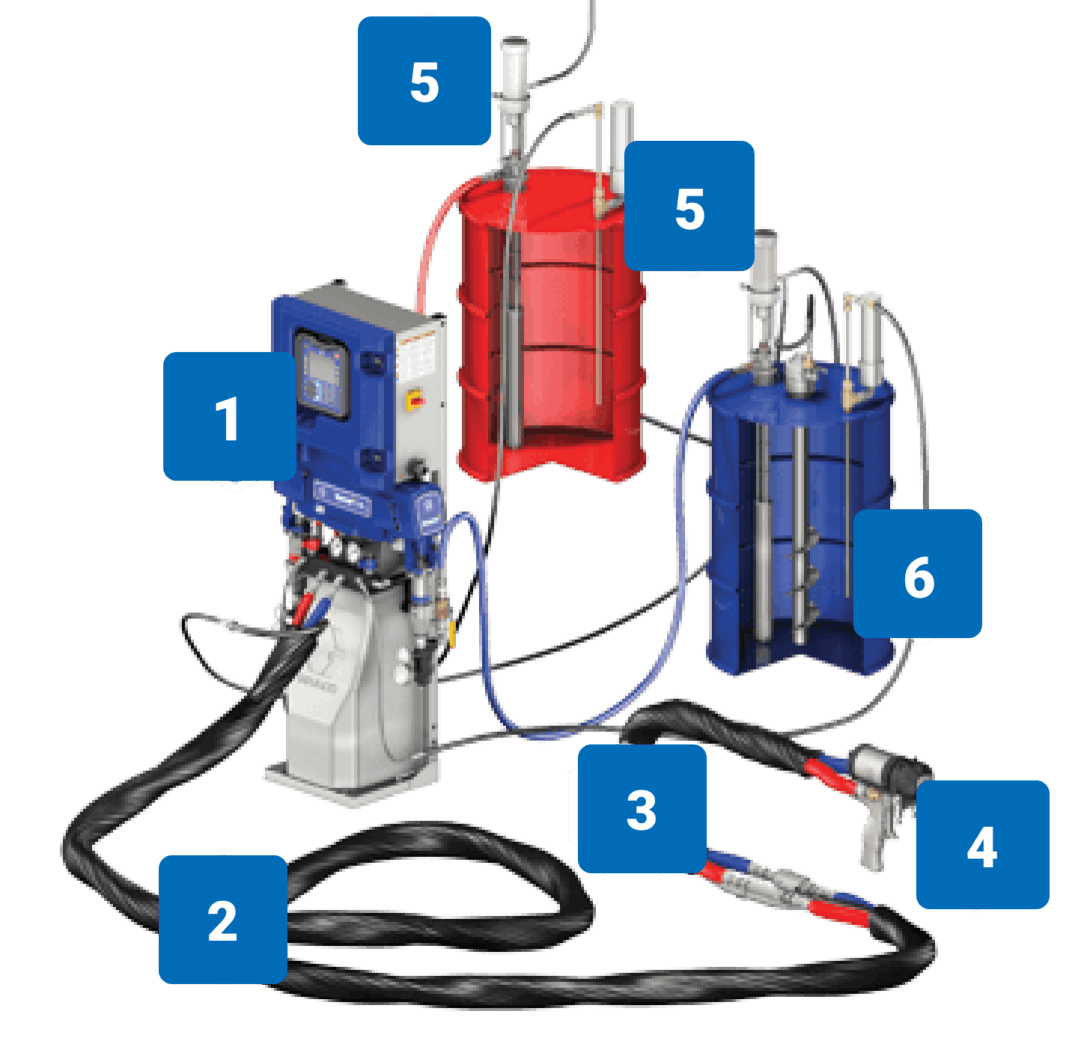
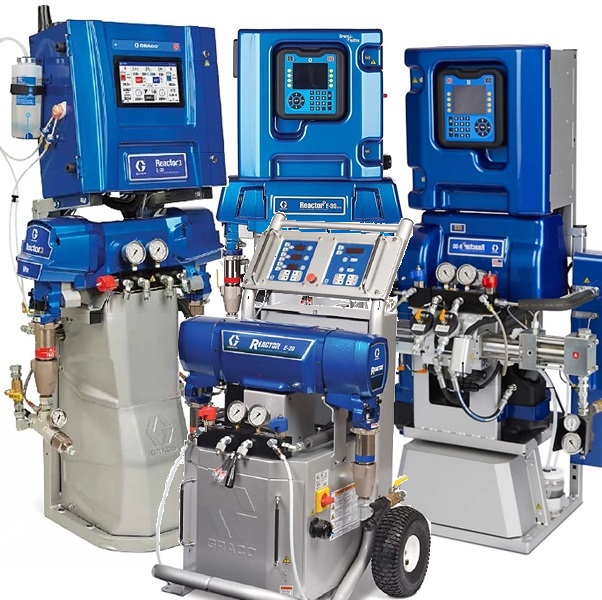
The Graco Reactor 2 Elite is Graco’s flagship heated plural component proportioner, purpose-built for spraying polyurea, polyurethane foam, and hybrid coatings. It represents a significant evolution over the original Reactor E-10 and E-30 lines, incorporating intelligent pressure control, advanced diagnostics, and a ruggedized design meant for the most demanding jobsite conditions.
Key Technical Specifications
The Reactor 2 Elite is available in multiple configurations — the H-25, H-40, and H-XP3 — covering a wide range of pressure and flow requirements. The H-40, the most commonly deployed configuration for infrastructure-grade polyurea work, delivers the following:
- Maximum working pressure: 3,500 PSI (241 bar)
- Maximum flow rate: 40 lb/min (18 kg/min)
- Heating capacity: Up to 195°F (91°C) heated hose temperature
- Proportioning ratio: 1:1 by volume (fixed)
- Power requirements: 208–240V, 3-phase or single-phase configurations available
- Weight: Approximately 565 lbs (256 kg)
- Compatible guns: Graco Fusion AP, Fusion FX, Fusion CS
These specs position the Reactor 2 Elite at the top tier of available plural component equipment, capable of handling fast-set pure polyurea chemistries that other machines simply cannot process reliably.
Intelligent Pressure Control (IPC): The Game-Changer
The standout innovation in the Reactor 2 Elite is Intelligent Pressure Control (IPC). Traditional plural component proportioners maintain pressure by running the hydraulic pump at a constant speed, which can cause significant pressure fluctuations — especially at the beginning and end of each spray pass or when working with long hose runs.
The Reactor 2 Elite’s IPC system monitors pressure in real time and adjusts pump motor speed to maintain consistent pressure throughout each trigger pull. The result is dramatically more uniform film thickness, fewer voids, and better adhesion — all critical when your polyurea coating is serving as the waterproofing membrane on a drinking water cistern or a bridge deck expansion joint.
In field testing on infrastructure projects, contractors report that IPC reduces material waste by 5–10% and significantly decreases the number of passes required to achieve target film thickness — directly reducing labor costs on large square-footage jobs.
Advanced Diagnostics and Remote Monitoring
The Reactor 2 Elite features Graco’s Advanced Display Module (ADM) — a full-color touchscreen interface that provides real-time data on temperatures, pressures, flow rates, and proportioning ratios. More importantly, the ADM logs job data, making it invaluable for quality control documentation on government-funded infrastructure projects that require certified spray records.
When connected via Graco’s InSite remote monitoring system, fleet managers and project supervisors can monitor machine performance from anywhere, receive alerts for off-ratio conditions before they become defective coatings, and pull comprehensive job reports for client submittals. This level of data transparency is increasingly required on federal and municipal infrastructure contracts.
Heating System and Hose Management
Pure polyurea chemistry is notoriously temperature-sensitive. Side A (isocyanate) and Side B (amine resin) must both be heated to specific temperatures — typically 140–160°F — and maintained at those temperatures throughout the hose run to ensure proper reactivity at the spray gun. The Reactor 2 Elite’s dual-zone heating system heats both sides independently and maintains temperature through up to 300 feet of heated hose.
This extended hose capacity is a significant field advantage. On infrastructure projects like bridge deck coatings or water treatment plant secondary containment, the proportioner may need to remain on a trailer or loading dock while the applicator works across a large open area. The Reactor 2 Elite handles these long runs without the temperature drop that causes off-ratio or under-reacted coatings.
Polyurea Coating for Infrastructure: Where the Graco Reactor 2 Elite Proves Its Value
Understanding why the Reactor 2 Elite is considered the best polyurea spray machine for infrastructure work requires a look at where these coatings are being applied and the performance demands of each application.
1. Bridge Deck Waterproofing and Joint Sealing
Bridge decks are among the most demanding polyurea applications. The coating must bond aggressively to prepared concrete, remain flexible enough to accommodate thermal expansion and contraction, resist chloride ion penetration from road salts, and withstand continuous traffic loading — all while maintaining watertightness. Pure polyurea applied at 80–120 mils DFT meets all of these requirements simultaneously.
The Federal Highway Administration (FHWA) has published guidance on bridge preservation coatings that increasingly references polyurea as a preferred system for deck membrane applications. States including California, Texas, Ohio, and New York are actively specifying polyurea on bridge rehabilitation projects funded through the Infrastructure Investment and Jobs Act.
2. Water and Wastewater Infrastructure
Drinking water cisterns, secondary containment berms, clarifier tanks, lift stations, and force main manholes represent a massive and growing market for polyurea coatings. The chemistry’s NSF/ANSI 61 certification (required for potable water contact) and its resistance to biological growth and chemical attack make it the preferred lining solution for water utilities nationwide.
The American Water Works Association (AWWA) estimates that the U.S. needs to invest more than $1 trillion in water infrastructure over the next 25 years. For coating contractors, this means decades of sustained demand — and the Reactor 2 Elite’s ability to apply NSF-certified polyurea formulations at production rates of 40+ pounds per minute makes it ideally suited to compete for this work.
3. Industrial Flooring and Secondary Containment
Manufacturing facilities, chemical plants, and distribution centers need floor coatings that can withstand forklift traffic, chemical spills, and thermal shock. Polyurea-based flooring systems applied with the Reactor 2 Elite deliver Shore D hardness above 60 while maintaining the elongation necessary to bridge concrete cracks — and they return the floor to service within hours of application, not days.
Secondary containment coatings for EPA-regulated storage areas must pass rigorous chemical resistance testing. Polyurea consistently passes immersion testing against hydrocarbons, acids, and bases at concentrations that would fail most competing systems. Contractors using the Reactor 2 Elite can confidently specify these coatings for EPA SPCC (Spill Prevention, Control, and Countermeasure) compliant containment projects.
4. Blast Mitigation and Force Protection
One of the most technically demanding polyurea applications is blast mitigation — coating concrete or masonry walls to prevent catastrophic fragmentation during explosive events. Research conducted at universities and military installations has demonstrated that polyurea-coated walls show dramatically reduced fragmentation and improved occupant survivability compared to uncoated or epoxy-coated structures.
The U.S. Army Corps of Engineers and Department of Defense have funded polyurea blast mitigation research and have approved its use on force protection projects. The Reactor 2 Elite, with its high-pressure delivery and precise proportioning, is one of the few machines capable of applying the thick-film pure polyurea coatings specified for blast mitigation work.
Graco Reactor 2 Elite vs. Competitors: How It Stacks Up
When contractors evaluate plural component equipment for infrastructure-grade polyurea work, the Reactor 2 Elite competes primarily against machines from Gusmer, Glascraft (now part of Graco), and Gama Technologies. Here’s how it compares on the dimensions that matter most to professional applicators:
Pressure Consistency
No competitor currently offers a pressure-control system comparable to Graco’s IPC. Competitive machines rely on fixed-speed or manually adjusted pump systems that require experienced operators to compensate for pressure fluctuations manually. The Reactor 2 Elite’s IPC delivers consistent results regardless of operator experience level — a significant advantage when training new spray technicians for a growing contracting business.
Diagnostics and Data Logging
Graco’s ADM and InSite platforms are unmatched in the industry. Competitive machines offer basic LED indicators or simple numeric displays. The Reactor 2 Elite provides a comprehensive digital record of every spray session, including time-stamped pressure and temperature data — documentation that is increasingly required on federally funded projects.
Dealer and Service Network
Graco operates one of the largest authorized dealer and service networks in the coatings industry, with certified service centers in virtually every major metropolitan area in the U.S. and Canada. When a machine goes down on a time-sensitive infrastructure project, having local service support is not a convenience — it’s a business-critical necessity. Graco’s network provides parts and factory-trained service technicians that competitive brands simply cannot match at scale.
Total Cost of Ownership: Is the Graco Reactor 2 Elite Worth the Investment?
The Reactor 2 Elite H-40 carries a list price in the range of $35,000–$45,000 depending on hose bundle length and gun configuration — a substantial investment for any contracting business. However, evaluating spray equipment on purchase price alone is a fundamental mistake. The true measure is total cost of ownership (TCO) over the machine’s productive lifespan.
Consider that a well-maintained Reactor 2 Elite will operate productively for 10–15 years with proper preventive maintenance. At a utilization rate of just 150 days per year — conservative for a busy infrastructure contractor — and an average billing rate of $3,000–$8,000 per day for polyurea spray services, a single machine generates $450,000 to $1.2 million in annual revenue. Amortized over a decade, the purchase price of the machine is a fraction of a percent of total revenue generated.
The Reactor 2 Elite’s IPC-driven material savings (reducing waste by 5–10%) and its reduced labor requirements (faster throughput, fewer passes to hit film thickness specs) further reduce operating costs. Graco also offers a comprehensive preventive maintenance program that keeps machines running at peak performance and extends service life.
Choosing the Right Spray Gun for Your Reactor 2 Elite Setup
The Reactor 2 Elite proportioner is only part of the equation. Selecting the right spray gun for your specific application is equally important. Graco’s three primary gun platforms each serve different use cases:
Graco Fusion AP (Air Purge)
The Fusion AP is the standard workhorse for most infrastructure polyurea applications. It uses a stream of purge air to clean the mixing chamber after each trigger release, making it suitable for spraying in place without solvent flushing. The AP is ideal for open-air bridge deck work, secondary containment, and any application where spray pauses are frequent.
Graco Fusion FX (Fast-Set)
The Graco Fusion FX was designed specifically for fast-set pure polyurea applications where the chemistry’s 3–5 second gel time demands precise, reliable mixing at every trigger pull. Its enhanced impingement mixing chamber delivers superior atomization at the pressures and flow rates that pure polyurea requires. For infrastructure coating projects specifying pure polyurea, the FX is typically the recommended gun pairing with the Reactor 2 Elite.
Graco Fusion CS (Mechanical Purge)
The Fusion CS uses a mechanical rod to clean the mixing chamber, making it suitable for slower-reacting hybrid polyurea and polyurethane systems where air purge is insufficient. It is less commonly used for pure polyurea infrastructure work but is the preferred option for hybrid systems that require a longer open time for film formation.
Getting Started: Training, Certification, and Growing Your Infrastructure Coating Business
Owning a Graco Reactor 2 Elite is just the beginning. Successful infrastructure coating contractors invest in three areas beyond the equipment itself: chemistry training, application technique, and business development.
On the chemistry side, polyurea chemistry suppliers like ArmorThane, SPI (Specialty Products Inc.), and Rhino Linings offer hands-on applicator training that covers material selection, surface preparation standards, spray technique, and quality control procedures. The Polyurea Development Association also offers formal certification programs that are increasingly recognized by specifying engineers and government agencies as a mark of technical credibility.
On the business development side, infrastructure coating contractors are successfully targeting municipal water utilities, state DOT bridge programs, industrial facility managers, and federal military installations. The key is obtaining the required contractor registrations (SAM.gov for federal work, state-specific vendor databases for municipal work) and building relationships with the civil engineering firms that write specifications for these projects.
Conclusion: The Graco Reactor 2 Elite Is the Definitive Choice for 2025 Infrastructure Coating Work
If you’re serious about capturing your share of the infrastructure coating market in 2025 and beyond, the equipment decision is straightforward. The Graco Reactor 2 Elite delivers the pressure consistency, diagnostic capability, thermal management, and dealer support that infrastructure-grade polyurea coating applications demand. No other machine on the market combines these attributes at the same level of integration and proven reliability.
Whether you’re waterproofing a drinking water cistern in rural Texas, protecting a bridge deck expansion joint in Ohio, or lining a secondary containment berm at an EPA-regulated petroleum facility in New Jersey, the Reactor 2 Elite is the best polyurea spray machine 2025 has to offer — and the investment it represents is among the most defensible capital expenditures a coating contractor can make in the current infrastructure boom.
For more in-depth reviews of Graco spray guns, polyurea chemistry comparisons, and contractor business guides, explore the rest of GracoReviews.com — your definitive resource for professional polyurea and spray coating equipment.
Disclaimer: GracoReviews.com is an independent review site. We are not affiliated with Graco Inc. All product information is based on publicly available manufacturer data and field experience from professional coating contractors. Always verify current specifications with your Graco distributor before purchasing.